March 2026
Peptides have quietly become one of the most talked-about topics in modern health and performance medicine. Athletes, longevity enthusiasts, and physicians alike have explored them for their potential to support healing, recovery, metabolism, and more.
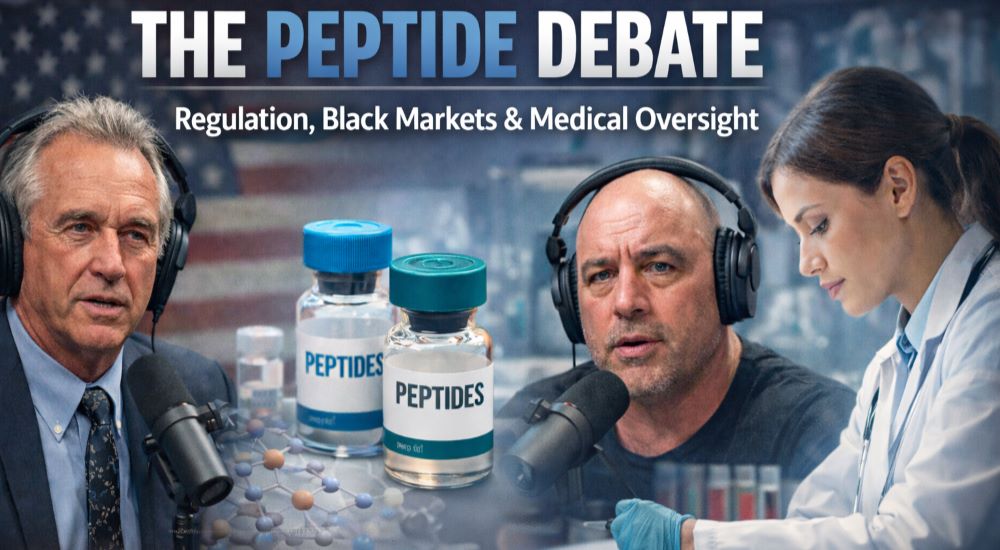
Recently, peptides returned to the spotlight when Robert F. Kennedy Jr. appeared on the Joe Rogan Experience, discussing the growing demand for peptide therapies and how regulatory decisions may have unintentionally contributed to the rise of a gray or black market.
The conversation highlighted a broader issue in healthcare: when legitimate access to emerging therapies becomes restricted or confusing, demand rarely disappears — it often shifts elsewhere.
Here’s what the discussion revealed about the peptide regulation problem and why medical oversight matters more than ever.
Why Peptides Have Gained So Much Attention
Peptides are short chains of amino acids that act as signaling molecules in the body. They play important roles in many biological processes, including:
- Tissue repair
- Hormone signaling
- Immune response
- Metabolism and body composition
- Recovery from injuries
Because peptides naturally occur in the body, researchers have studied them for decades as tools that may help support healing and physiological balance.
In recent years, interest has surged as physicians in functional and longevity medicine began exploring peptide-based therapies to support recovery, metabolic health, and healthy aging.
But as public awareness increased, regulation followed.
The Regulatory Issue Discussed on the Podcast
During the podcast, Robert F. Kennedy Jr. explained that compounding pharmacies historically produced certain peptides under a legal framework designed to help patients access customized medications.
Compounding pharmacies are allowed to create medications tailored to a patient’s needs when:
- A commercial drug formulation isn’t suitable
- A patient has allergies to certain ingredients
- A specific dosage or delivery method is required
According to Kennedy’s comments during the conversation, 19 peptides that were commonly compounded were later moved into a regulatory category known as “Category 2,” which discouraged pharmacies from producing them.
Kennedy stated that this shift occurred without what he described as a clear safety signal, which he argued is typically required before restricting compounding access.
Whether regulators agree with that interpretation remains part of an ongoing policy debate, but the discussion reflects broader concerns about how emerging therapies are evaluated and regulated.
How a Gray Market for Peptides Emerged
Kennedy argued during the conversation that when access through compounding pharmacies became more limited, demand for peptides did not disappear.
Instead, he said a gray market quickly filled the gap.
Today, many peptides are sold online labeled as:
- “Research use only”
- “Not for human consumption”
- “Veterinary use”
These labels often allow sellers to operate in a regulatory gray area.
During the discussion, Joe Rogan noted that the biggest concern with these products is that consumers purchasing from the grey market often have no reliable way of verifying their quality or authenticity.
The Risks of Unregulated Peptides
Without medical oversight or pharmaceutical-grade standards, consumers purchasing peptides online may not know:
- What the product actually contains
- Whether the dosage is accurate
- If the peptide has degraded or been contaminated
- Whether the protocol is appropriate for their health
This uncertainty is one of the primary concerns raised by physicians and researchers as peptide demand continues to grow.
In contrast, when therapies are sourced through legitimate medical channels, providers typically rely on verified supply chains and pharmaceutical standards designed to ensure product identity and purity.
Why Medical Oversight Matters
Emerging therapies are safest when guided by qualified medical professionals.
Responsible peptide therapy typically involves:
- Comprehensive lab testing
- Evaluation of metabolic and hormonal markers
- Individualized treatment protocols
- Ongoing monitoring and adjustments
That kind of structure helps ensure that therapies are not only promising but also appropriate for the individual patient.
Forum Health providers follow this kind of personalized approach. Rather than offering one-size-fits-all treatments, physicians evaluate symptoms, health history, and laboratory data to determine whether a therapy is appropriate and how it should be tailored to the individual. Providers frequently review detailed lab markers — including hormone levels, metabolic health indicators, and other biomarkers — to guide treatment decisions.
This type of medical framework provides something missing in the gray market: clinical evaluation, transparency, and ongoing oversight.
Bridging the Gap Between Innovation and Safety
The conversation on Joe Rogan reflects a larger shift happening across healthcare.
More patients today are seeking:
- personalized therapies
- data-driven treatment plans
- approaches that address root causes rather than only symptoms
At the same time, the popularity of peptides has created confusion about where patients can access legitimate treatments and whom they can trust.
That’s where experienced medical providers play an important role. Forum Health offers physician-guided peptide therapies within a model built around medical evaluation, advanced diagnostics, and personalized care. Providers assess each patient individually — reviewing health history, symptoms, and blood work — before recommending treatment strategies designed specifically for that person.
This approach reflects Forum Health’s broader philosophy of combining advanced diagnostics with individualized care plans that address the root causes of health challenges rather than simply masking symptoms.
In an environment where peptides are widely discussed but often poorly understood, that kind of medical structure helps give patients a clearer path forward.
The Bottom Line
The peptide conversation unfolding across podcasts, medical conferences, and research institutions reflects a simple reality: demand for innovative therapies is not slowing down.
But as interest grows, so do the risks of misinformation, inconsistent quality, and products sold outside legitimate medical channels.
Patients are clearly looking for access to promising peptide therapies. The real question is not just whether these treatments exist — it is how they can be accessed safely, responsibly, and with the right medical oversight.
That is where trusted healthcare providers make a difference.
Forum Health works to bridge that gap by offering peptide therapies through a physician-guided model that emphasizes testing, individualized care, and clinical oversight. Instead of navigating the gray market alone, patients can work with experienced doctors who evaluate their health data and recommend treatments based on science, safety, and the individual’s needs.
Ultimately, the peptide debate is about more than regulation. It is about access, trust, and ensuring that promising medical innovations can be delivered responsibly to the patients who may benefit from them most.
Sources: